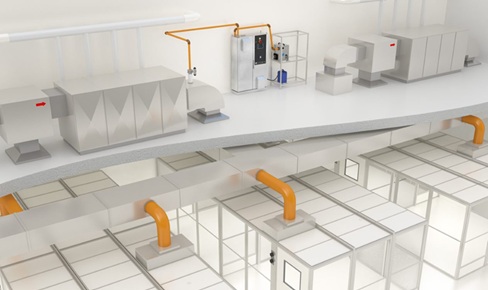
Vaporized Hydrogen Peroxide (VHP) has been the global benchmark for surface biodecontamination at ambient temperature for more than 35 years. By leveraging the sporicidal properties of hydrogen peroxide in its vapor phase, VHP achieves high-level decontamination without imposing any thermal stress on sensitive materials, making it ideal for pharmaceutical and biosafety applications. Initially developed for isolator biodecontamination, VHP technology has evolved to address larger controlled environments, including cleanrooms, airlocks, and material transfer chambers.
Modern VHP systems integrate seamlessly with HVAC infrastructures to ensure uniform vapor distribution and controlled aeration phases. These solutions enable fully automated and traceable cycle execution with validated parameters for concentration, exposure time, and humidity control. Compliance with EU GMP Annex 1 (2022), ISO 14644-3, ISO 17272, PIC/S guidelines, and FDA requirements ensures reproducibility and regulatory alignment. Validation strategies typically include achieving easily 6-log reduction in bioburden using biological indicators . The system architecture is underpinned by stringent data integrity controls, ensuring full compliance with 21 CFR Part 11 requirements for electronic records, audit trails, and system security. It is engineered to be interoperable and scalable, aligning with Pharma 4.0 principles for advanced automation, digitalization, and regulatory readiness.
This presentation provides a comprehensive overview of the rationale and strategies for VHP integration in pharmaceutical and biosafety level (BSL) environments. Drawing on more than a decade of operational experience from multiple installations worldwide, we will address technical challenges, regulatory expectations, and lessons learned. Key topics include HVAC integration, cycle design optimization, material compatibility, data traceability and security, risk mitigation approaches that reduce manual interventions and contamination risks. Real-world case studies will illustrate best practices and long-term performance outcomes.