
This presentation examines the nature, risks, and control of disinfectant residues in cleanroom environments, with particular emphasis on regulatory expectations, microbiological impact, and validated mitigation strategies.
1. Nature and Risk of Disinfectant Residues
Disinfectant residues are non-volatile substances remaining on surfaces after application, excluding alcohols and hydrogen peroxide, which are effectively residue-free. Residues arise from both disinfectants and detergents and can accumulate incrementally and non-linearly over time. Their presence poses multiple risks: interference with subsequent disinfection efficacy, adverse effects on media neutralisation, potential support of microbial survival or growth, surface corrosion, health and safety issues, and transfer to product-contact areas.
2. Regulatory and GMP Context
GMP Annex 1 (2022) explicitly reinforces the expectation that cleaning programmes remove disinfectant residues and that cleaning and disinfection are distinct, validated activities. Regulatory scrutiny is increasing: analysis of FDA 483 observations shows residue-related findings in ~27% of cited cases.
3. Prevalence and Characteristics of Residues in Practice
Contec Contamination Control Assessments across pharma, biotech, and healthcare facilities demonstrated that residues were observed in nearly all sites, most commonly associated with quaternary ammonium compound (QAC) use.
4. Residue Formation, Accumulation, and Removal
Residue load does not correlate linearly with active concentration or “low residue” marketing claims. EP Residue on Evaporation (RoE) testing provides a useful comparative worst-case metric, but there is no agreed definition of “low residue” beyond alcohols and hydrogen peroxide. Importantly, residues that are initially free-rinsing can become increasingly difficult to remove over time due to surface binding.
5. Validation and Mitigation Strategies
Effective residue control requires a risk-based, validated approach within the Contamination Control Strategy (CCS). Key elements include:
o Understanding residue generation via RoE and surface studies
o Selecting appropriate removal agents (water, IPA, detergents) based on residue chemistry and surface compatibility
o Validating residue removal on worst-case surfaces using routine SOPs
o Defining frequency and timing of residue removal stages
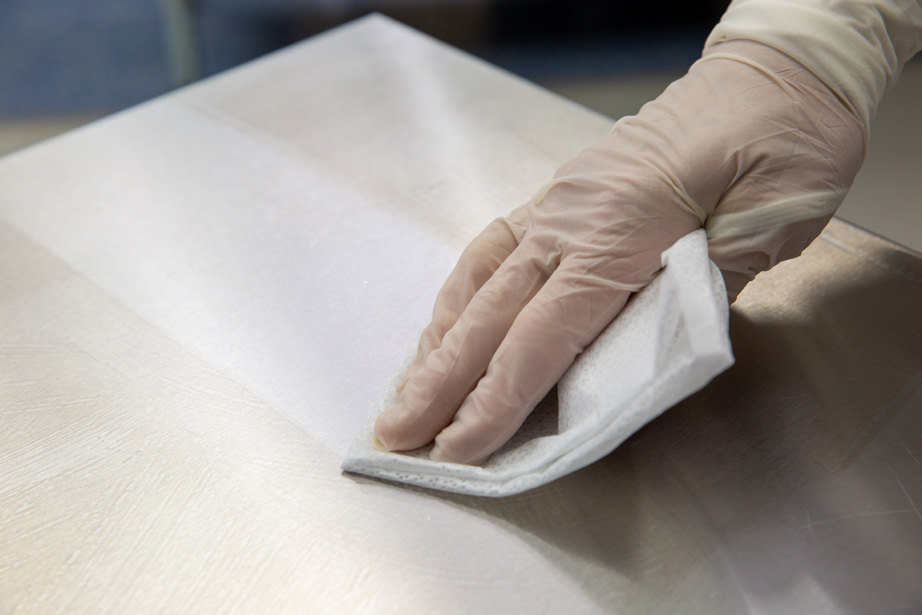
o Recognising that solubilisation followed by removal with a dry wipe is more effective than saturated wipes alone
Overall conclusion: disinfectant residues represent a widespread, under-controlled risk with microbiological, operational, and regulatory implications. While “low residue” claims are poorly defined, residues that are easily removable (“free-rinsing”) and proactively managed through validated processes are more meaningful from a quality and contamination control perspective.