Trespa TopLab at Roslin Innovation Centre
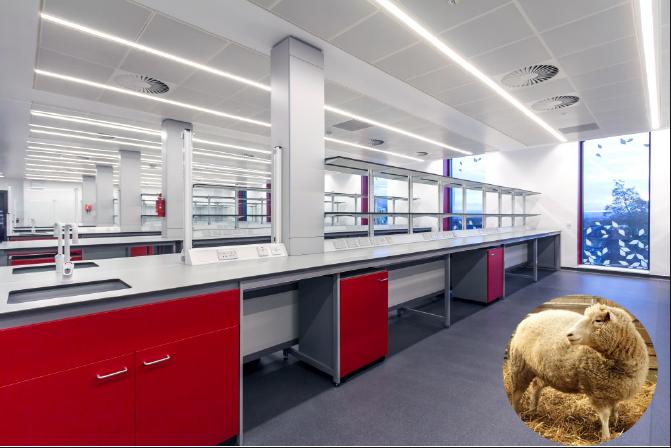 Opened in 2017, the laboratories of the Roslin Inno-vation Centre serve as an incubator space for animal bioscience research at the University of Edinburgh’s Easter Bush Campus. Located across three floors in both north and south blocks of the complex, the new laboratories have an open plan and host 285 worksta-tions that showcase furniture manufactured with Trespa® TopLab®.
Dolly was born in 1996 as part of a series of experi-ments of scientists at the University’s Roslin Institute, nearby the Roslin Innovation Centre on the Easter Bush Campus. Dolly - who was named after country singer Dolly Parton - was cloned from a cell taken from the mammary gland of a six-year-old Finn Dor-set sheep and an egg cell taken from a Scottish Blackface sheep.
Dolly’s white face was one of the first signs that she was a clone, because if she were genetically related to her surrogate mother, she would have had a black face. Dolly was not the first mammal to be cloned, but the first to be created from an adult cell and not from embryonic or foetal cells. She pro-ved that already specialised cells - such as brain or liver cells - could be used to create an exact copy of the animal they came from. Dolly’s creation sparked a global ethical debate about how far science should go, but also boosted new stem cell research.